
Description
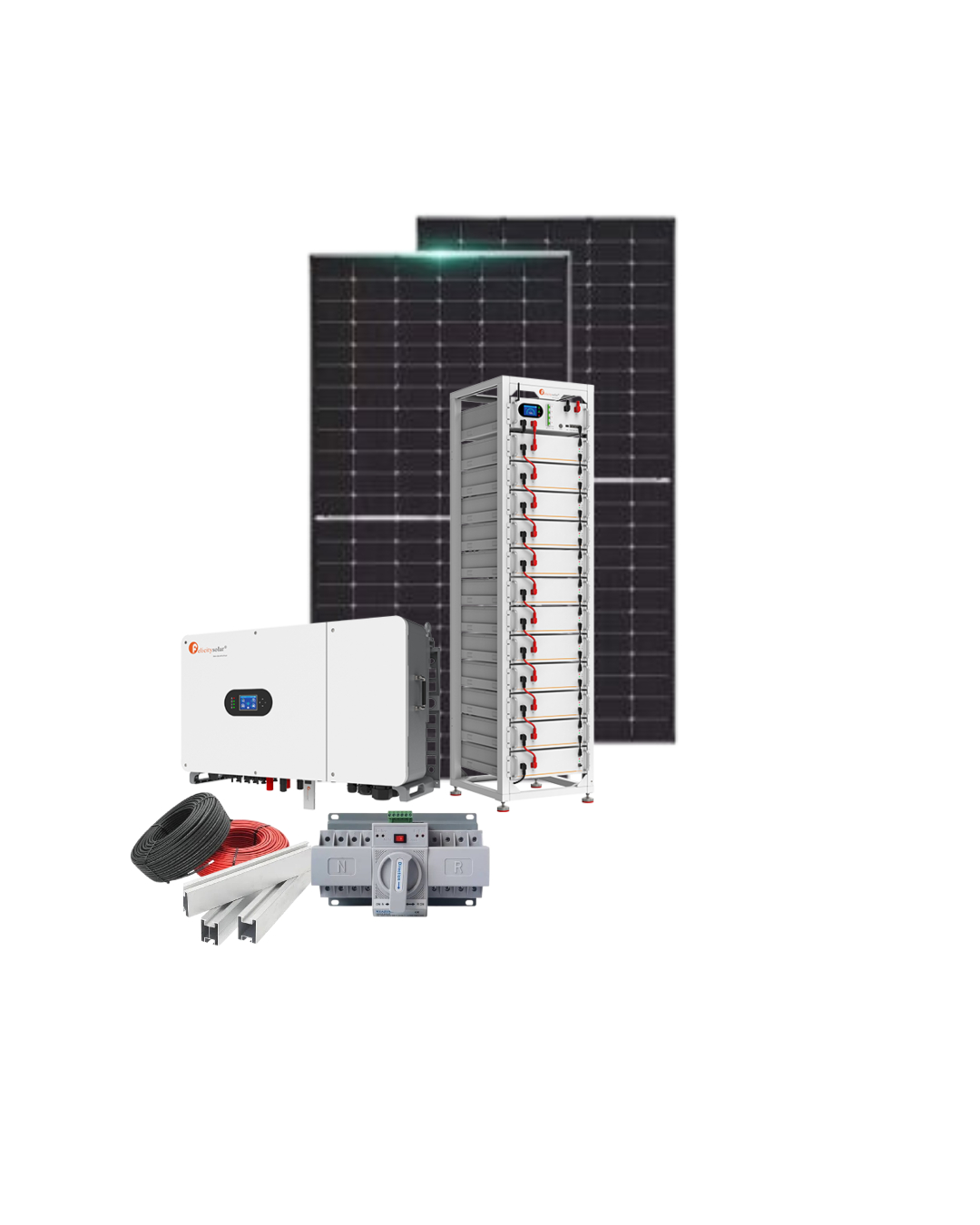
33 kVA / 30 kW Felicity High-Voltage Three-Phase Hybrid Solar System
A Powerful Solar Energy Solution for Commercial,industrial and Institutional Applications
1. System Overview
The 33 kVA / 30 kW Felicity High-Voltage Three-Phase Hybrid Solar System is a high-performance solar power solution designed to provide reliable, efficient and flexible energy for commercial buildings, industrial facilities, offices, hotels, schools, hospitals, agricultural enterprises and other businesses with substantial electricity demands.
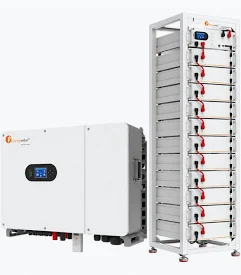
The system features the Felicity IVGM30KHP3G2 30 kW three-phase hybrid inverter, an integrated 48 kW MPPT solar charge controller, and a 30.72 kWh high-voltage battery storage system. It combines solar energy generation, battery storage and grid integration to help reduce electricity costs while providing dependable power for essential operations.
With support for up to 72 solar panels rated between 550 W and 700 W, this system offers substantial solar generation capacity and the flexibility to support a wide range of commercial and industrial loads.
The IP65-rated inverter enclosure provides protection against dust and water ingress, making it suitable for installations in demanding environments when installed according to the manufacturer’s requirements.
The system also supports Wi-Fi monitoring, enabling users to monitor system performance and energy production.
2. Main System Components and Specifications
A. Felicity 33 kVA / 30 kW Three-Phase Hybrid Inverter
Model: IVGM30KHP3G2
The Felicity IVGM30KHP3G2 is a high-voltage, three-phase hybrid inverter designed to manage energy from solar panels, battery storage and the electricity grid. It provides intelligent energy conversion and management, helping businesses make greater use of solar power while maintaining a reliable electricity supply.
Its on-grid and off-grid functionality allows the system to integrate with the utility grid while also supporting backup power operation, subject to the inverter’s operating configuration and installation requirements.
Key inverter specifications
| Specification | Details |
|---|---|
| Manufacturer | Felicity Solar |
| Model | IVGM30KHP3G2 |
| Rated inverter capacity | 33 kVA / 30 kW |
| Inverter type | High-voltage hybrid inverter |
| Phase configuration | Three-phase |
| Operating modes | On-grid and off-grid |
| Enclosure protection | IP65 |
| Built-in MPPT capacity | 48 kW |
| MPPT configuration | 3 × 16 kW |
| Maximum PV input voltage | 850 V DC |
| PV input voltage range | 150–850 V DC |
| Maximum PV input current | 36 A per MPPT |
| PV input ports | 6 |
| Battery input voltage range | 160–800 V DC |
| Maximum supported solar panels | Up to 72 panels, subject to electrical design |
| Supported panel ratings | 550 W–700 W |
| Monitoring | Wi-Fi module |
| Warranty | 5 years |
Advantages of the Felicity hybrid inverter
1. High power output for commercial applications
With a rated output of 30 kW and a capacity of 33 kVA, the inverter is designed to support substantial electrical loads in commercial and industrial environments. It can serve facilities with three-phase equipment, machinery, pumps, refrigeration systems, office equipment and other compatible electrical appliances.
The actual loads supported will depend on their combined power demand, power factor, starting currents and the inverter’s overload specifications.
2. Three-phase power supply
The three-phase configuration makes the inverter suitable for installations requiring three-phase electricity. It can support appropriately distributed loads across the three phases, making it useful for businesses with three-phase motors and industrial equipment.
3. Large solar input capacity
The built-in 48 kW MPPT capacity allows the inverter to manage a substantial solar array. This provides the flexibility to install more solar generation capacity than the inverter’s 30 kW rated AC output, within the manufacturer’s approved limits.
A properly designed system can use the available solar energy to operate daytime loads and charge the battery bank when surplus solar power is available.
4. Intelligent MPPT technology
The inverter incorporates three MPPT channels, each rated at 16 kW according to the supplied specifications.
Maximum Power Point Tracking (MPPT) technology continuously adjusts the operating point of the solar array to capture available power efficiently as sunlight and panel temperatures change.
The six PV input ports provide flexibility when configuring solar panel strings. The final string arrangement must comply with the inverter’s voltage, current and input-power limits.
5. High-voltage battery compatibility
The inverter supports a battery input voltage range of 160–800 V DC. This enables integration with a compatible high-voltage battery system designed for the inverter.
High-voltage battery systems can provide efficient energy transfer between the battery and inverter, subject to the equipment’s operating characteristics.
6. On-grid and off-grid capability
The hybrid design enables the system to use solar energy, battery storage and grid electricity according to its configuration and operating settings.
During periods of sufficient sunlight, solar energy can supply connected loads. Excess energy may be used to charge the battery, while the grid can supplement supply when solar production and stored energy are insufficient.
During a grid outage, the inverter can supply supported loads through its backup or off-grid output, provided the installation is configured for this operation and the connected loads remain within the inverter’s limits.
7. IP65-rated enclosure
The IP65 enclosure rating provides protection against dust ingress and water jets. This is beneficial in environments where equipment may be exposed to dust or occasional water splashes.
The inverter should nevertheless be installed in a suitable location with adequate ventilation, temperature control and compliance with the manufacturer’s installation instructions.
8. Wi-Fi monitoring
The supplied Wi-Fi module allows users to monitor system operation through the supported monitoring platform. Depending on the available monitoring functions, users may be able to view solar generation, battery status, energy consumption and system operating conditions.
This helps facility managers understand energy performance and identify potential operating issues.
B. Felicity 30.72 kWh High-Voltage Battery Storage System
The system incorporates a 30.72 kWh Felicity lithium battery storage package, consisting of one master battery controller and six 5.12 kWh slave battery modules.
The battery bank stores surplus solar energy generated during the day for use during periods of low solar production, including evenings, nights and temporary grid interruptions.
This storage capacity is particularly useful for commercial premises that need to maintain selected operations after sunset or reduce their reliance on grid electricity during expensive tariff periods.
Battery system components
| Component | Model | Quantity | Specification |
|---|---|---|---|
| Master battery controller | FLH48100UCG2 | 1 | Battery management and control |
| Slave lithium battery modules | FLH48100UMG2 | 6 | 48 V, 100 Ah, 5.12 kWh each |
| Battery rack | FLH48100UG2 | 1 | Seven-layer battery rack |
| Total nominal battery capacity | — | — | 30.72 kWh |
1. Felicity Master Battery Controller
Model: FLH48100UCG2
The FLH48100UCG2 master unit forms part of the battery management and control arrangement. It coordinates the compatible battery modules and supports communication between the battery bank and the inverter.
A properly configured battery management system helps monitor battery operating conditions and supports protective functions according to the manufacturer’s design.
Key benefits:
- Coordinates the connected battery modules.
- Supports communication with compatible inverter equipment.
- Helps manage battery operating conditions.
- Supports the coordinated operation of the battery storage bank.
- Contributes to safe and reliable battery system operation when installed according to manufacturer requirements.
Warranty: 7 years, with an additional 3-year warranty extension as specified in the supplied information. The precise coverage and conditions should be confirmed with the supplier.
2. Felicity 5.12 kWh Lithium Battery Modules
Model: FLH48100UMG2
The system includes six Felicity 5.12 kWh lithium battery modules, each rated at 48 V and 100 Ah according to the supplied specifications.
These modules use Grade A lithium battery cells and are designed to provide rechargeable energy storage for compatible solar inverter systems.
The six modules provide a combined nominal storage capacity of:
6 × 5.12 kWh = 30.72 kWh
Individual battery specifications
| Specification | Details |
|---|---|
| Manufacturer | Felicity Solar |
| Model | FLH48100UMG2 |
| Battery type | Lithium battery |
| Cell grade | Grade A |
| Nominal voltage | 48 V |
| Rated capacity | 100 Ah |
| Nominal energy capacity | 5.12 kWh |
| Quantity | 6 units |
| Combined nominal capacity | 30.72 kWh |
| Application | Solar energy storage |
| Warranty | Confirm the applicable warranty for the slave modules |
Advantages of the lithium battery bank
Reliable energy storage: The battery bank stores surplus solar electricity for later use, helping the facility maintain access to stored energy when solar production declines.
Reduced grid dependence: Businesses can use stored solar energy in the evening or at other times when grid electricity would otherwise be required.
Modular design: The six-module arrangement provides a total nominal capacity of 30.72 kWh, with individual modules forming part of a coordinated storage system.
Battery management: When operated with the compatible master controller and inverter, the battery system can monitor and manage relevant battery operating parameters.
Support for backup power: During a grid interruption, the battery can supply energy through the inverter to compatible, supported loads, provided the system is correctly configured and the battery has sufficient charge.
Improved solar energy utilisation: Storing excess daytime generation can help reduce solar energy wastage when production exceeds immediate consumption.
Understanding the available battery backup
Although the battery bank has a nominal capacity of 30.72 kWh, the amount of energy available to connected loads will be lower or otherwise affected by battery operating limits, inverter conversion losses, reserve settings and the battery’s state of charge.
For illustration:
| Average connected load | Approximate theoretical runtime using 30.72 kWh |
|---|---|
| 2 kW | 15.36 hours |
| 3 kW | 10.24 hours |
| 5 kW | 6.14 hours |
| 10 kW | 3.07 hours |
| 15 kW | 2.05 hours |
| 20 kW | 1.54 hours |
| 30 kW | 1.02 hours |
These figures are theoretical estimates calculated using the full nominal battery capacity, without accounting for losses or battery reserve limits. Actual backup times will generally be shorter and will depend on the usable battery capacity and the connected load.
For example, a business drawing an average of 5 kW could theoretically obtain approximately 6.14 hours of operation from the nominal battery capacity. The actual runtime would depend on the system’s operating conditions.
Important: The inverter is rated at 30 kW, but the 30.72 kWh battery bank is primarily an energy-storage measure, not a guarantee that the system can sustain a 30 kW load for extended periods. Battery discharge limits and compatibility must be verified to establish the maximum supported power.
3. Felicity Seven-Layer Battery Rack
Model: FLH48100UG2
The FLH48100UG2 is the specified seven-layer rack for housing and organising the battery system.
The rack provides a dedicated arrangement for installing the compatible battery modules and helps keep the battery bank organised within the equipment area.
Advantages:
- Provides organised battery installation.
- Helps maintain a neat and professional equipment layout.
- Facilitates access for inspection and maintenance.
- Helps consolidate the battery modules in a designated location.
- Supports an orderly installation when used according to the manufacturer’s requirements.
The rack should be installed on a suitable, stable surface with sufficient access and clearance for maintenance and any ventilation requirements.
3. Solar Panel Capacity and Configuration
The inverter specifications provided indicate that the system can accommodate up to 72 solar panels rated between 550 W and 700 W, subject to the manufacturer’s electrical limits and the final system design.
The exact solar array capacity will depend on the wattage of the selected modules.
Solar generation capacity
| Panel rating | Number of panels | Total DC solar capacity |
|---|---|---|
| 550 W | 72 | 39.60 kWp |
| 600 W | 72 | 43.20 kWp |
| 635 W | 72 | 45.72 kWp |
| 650 W | 72 | 46.80 kWp |
| 670 W | 72 | 48.24 kWp |
| 700 W | 72 | 50.40 kWp |
For example, using 72 panels rated at 635 W each would provide a total installed solar capacity of 45.72 kWp.
This offers substantial daytime generation potential for commercial operations.
Actual electricity production will depend on sunlight availability, shading, panel orientation, installation angle, temperature, dust, cable losses and other site conditions.
Solar panel string configuration
The supplied configuration indicates three groups of solar inputs, with 12 × 2 panels per group, for a total of 72 panels.
However, the final string design must be verified against the actual module specifications and inverter input limits.
In particular, the installer must confirm:
- Maximum open-circuit voltage of each PV string under the lowest expected site temperature.
- Maximum operating voltage and MPPT tracking range.
- Maximum operating current and short-circuit current for each MPPT.
- The correct number of strings connected to each input.
- Compliance with the inverter’s maximum permitted PV input power.
Technical note: The supplied description mentions six PV input ports and three MPPT channels, with a maximum current of 36 A per MPPT. The manufacturer’s connection diagram should be checked before confirming the proposed 72-panel arrangement.
4. How the System Works
The Felicity 33 kVA / 30 kW hybrid solar system combines solar generation, battery storage and grid integration to provide a flexible energy supply.
During the day
The solar panels generate electricity from sunlight. The inverter converts the available DC electricity into usable AC power for connected three-phase loads.
Solar electricity can supply operating equipment, lighting, computers, refrigeration, pumps and other compatible appliances.
When solar production exceeds immediate consumption, surplus energy can be directed to charge the battery bank, subject to the system’s charging limits and operating settings.
During the evening and at night
When solar production decreases or stops, the system can use energy stored in the battery bank to supply supported loads.
This allows the business to continue using previously generated solar electricity instead of relying entirely on grid power.
The duration of battery operation depends on the load and the usable energy remaining in the battery bank.
During a grid outage
Where the inverter has been configured for backup or off-grid operation, it can supply supported loads from solar generation and available battery energy.
The essential loads must remain within the inverter’s rated output and other applicable limits.
Critical equipment should be prioritised through appropriate load management to help maximise backup duration.
When solar and battery energy are insufficient
The system can use the grid to supplement the energy supply where grid connection and operating settings permit.
This flexibility helps businesses maintain operations while making greater use of available solar energy.
5. Major Advantages of the 33 kVA / 30 kW Felicity Solar System
1. Reduced electricity bills
The system can offset a significant portion of daytime electricity consumption using solar energy.
Businesses with substantial daytime loads may benefit particularly from generating electricity on-site rather than purchasing all their energy from the utility provider.
2. Three-phase commercial power
The three-phase inverter design makes the system suitable for compatible commercial and industrial installations requiring three-phase power.
It can support a range of equipment, provided the loads are properly sized and balanced.
3. Integrated battery backup
The 30.72 kWh battery bank stores surplus solar energy for use when sunlight is unavailable or insufficient.
This helps improve energy availability and can support selected operations during grid interruptions.
4. Large solar array capacity
With a built-in 48 kW MPPT rating and support for appropriately configured PV strings, the system can accommodate a substantial solar array.
This provides flexibility for businesses with significant daytime energy requirements.
5. Hybrid operating flexibility
The combination of solar panels, battery storage and grid integration allows the system to adapt to different energy conditions.
It can prioritise solar energy and use other available sources according to the configured operating strategy.
6. Protection against dust and water ingress
The inverter’s IP65-rated enclosure provides useful protection in demanding installation environments when the manufacturer’s mounting and environmental requirements are followed.
7. Intelligent system monitoring
The Wi-Fi monitoring facility helps users monitor system performance through the compatible monitoring platform.
This can improve visibility into energy generation, battery status and system operation.
8. Scalable energy management
The system’s configuration provides a structured approach to combining solar generation and battery storage.
Any future expansion must be assessed against the inverter’s permitted PV input, battery compatibility, available electrical capacity and installation requirements.
9. Suitable for a variety of applications
The system may be suitable for:
- Commercial office buildings.
- Hotels and hospitality facilities.
- Schools and educational institutions.
- Hospitals and healthcare facilities.
- Agricultural operations.
- Warehouses and distribution centres.
- Workshops and light industrial facilities.
- Commercial refrigeration and cold-storage facilities.
- Properties with substantial daytime electricity demand.
The suitability of the system for any specific application should be confirmed through a load assessment, especially where large motors, compressors, medical equipment or other critical loads are involved.
6. Warranty and Product Support
The supplied component information specifies the following warranty periods:
| Component | Warranty |
|---|---|
| Felicity IVGM30KHP3G2 hybrid inverter | 5 years |
| FLH48100UCG2 master battery controller | 7 years + 3-year extension, as supplied |
| FLH48100UMG2 slave battery modules | Confirm with the supplier |
| FLH48100UG2 battery rack | Confirm with the supplier |
Warranty coverage should be verified against the manufacturer’s documentation, registration requirements and applicable installation conditions.
7. Important System Design Considerations
Before installation, a qualified solar technician should confirm the following:
Battery voltage compatibility: The battery arrangement must provide the high-voltage DC range required by the inverter. The listed 48 V, 100 Ah slave modules should not be assumed to connect directly to a 160–800 V battery input without the manufacturer’s specified high-voltage battery architecture, control equipment and wiring arrangement.
Battery configuration: The six 5.12 kWh slave modules add up to 30.72 kWh of nominal energy. However, their suitability for the inverter depends on the manufacturer’s approved configuration. The master controller, battery modules and any required high-voltage conversion or series-connection architecture must be confirmed.
PV input limits: The final panel arrangement must comply with the inverter’s voltage, current and power limits under all expected operating conditions.
Load assessment: A load audit should identify the facility’s average consumption, peak demand, motor starting currents and essential backup loads.
Protection and installation: Appropriate DC and AC protection, earthing, surge protection, isolators, cable sizing and changeover arrangements should be incorporated into the final installation design.
Important technical verification: The inverter model and the supplied 48 V battery-module specifications should be checked against Felicity Solar’s official compatibility documentation before the system is sold or installed as a complete high-voltage package. The 30.72 kWh capacity calculation is correct, but the stated battery components alone do not establish that the complete battery bank is electrically compatible with the inverter’s 160–800 V input.
8. Final Summary
The Felicity 33 kVA / 30 kW High-Voltage Three-Phase Hybrid Solar System is designed to help commercial and industrial users reduce electricity expenses, make better use of solar energy and improve access to backup power.
Its main features include a 30 kW three-phase hybrid inverter, a built-in 48 kW MPPT solar charge controller, Wi-Fi monitoring, an IP65-rated inverter enclosure and a proposed 30.72 kWh lithium battery storage package.
With an appropriately sized solar array and a correctly configured battery system, the installation can provide a flexible energy solution for facilities that consume substantial amounts of electricity during the day and require selected loads to continue operating when solar production declines.
Recommended application: Commercial and industrial premises seeking to reduce grid electricity consumption while incorporating solar generation and battery backup into their energy supply
📞📞CALL US N:0799316769/0708549953


Reviews
There are no reviews yet.