
Description
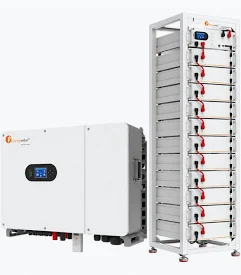
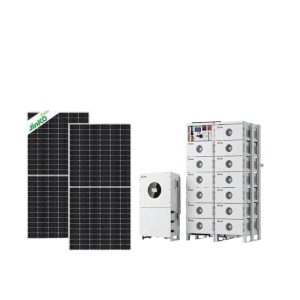
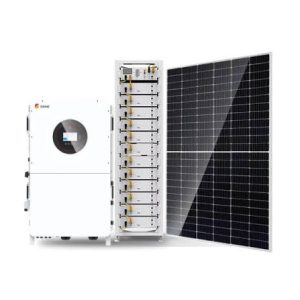
55KVA / 50kW Felicity High-Voltage Three-Phase Hybrid Solar System
Model: IVGM50KHP3G2 | 80kW Built-in MPPT | On-Grid & Off-Grid | IP65 Protection
1. System Overview
The 55KVA / 50kW Felicity High-Voltage Three-Phase Hybrid Solar System is a powerful solar energy solution designed for commercial, industrial, agricultural, and institutional applications that require reliable electricity, reduced energy costs, and dependable backup power.
At the heart of this system is the Felicity IVGM50KHP3G2 50kW three-phase hybrid inverter, which combines solar power generation, high-voltage battery storage, grid connectivity, and intelligent energy management in one advanced system. Its built-in 80kW Maximum Power Point Tracking (MPPT) capacity enables it to manage a substantial solar PV array, making it suitable for businesses with significant daytime electricity consumption.
The system can be configured to operate in both on-grid and off-grid modes, depending on the installation requirements, available grid supply, and battery configuration. During sunny hours, solar energy can power connected equipment directly, with surplus energy available for charging the batteries or exporting to the grid where permitted and properly configured.
When solar production decreases, the system can draw energy from the high-voltage battery bank or the grid, depending on the operating settings and system configuration. During a grid outage, it can provide backup power to supported loads when correctly configured with a compatible battery bank.
With its IP65-rated enclosure, high-capacity solar input, and three-phase output, this inverter provides a practical foundation for businesses seeking to improve energy independence and manage long-term electricity expenses.
2. Main System Components and Specifications
A. Felicity 55KVA / 50kW Three-Phase Hybrid Inverter
Model: IVGM50KHP3G2
The IVGM50KHP3G2 is a high-capacity hybrid inverter designed to integrate solar PV generation, high-voltage battery storage, and grid electricity. Its three-phase architecture makes it suitable for commercial and industrial facilities operating machinery, pumps, production equipment, and other three-phase electrical loads.
Key specifications
| Specification | Details |
|---|---|
| Manufacturer | Felicity Solar |
| Model | IVGM50KHP3G2 |
| Inverter apparent power | 55kVA |
| Rated active power | 50kW |
| Inverter type | High-voltage hybrid inverter |
| Phase configuration | Three-phase |
| Operating modes | On-grid and off-grid, subject to configuration |
| Protection rating | IP65 |
| Built-in MPPT capacity | 80kW |
| MPPT configuration | 4 MPPT trackers, rated at 20kW each |
| PV input voltage range | 150–850V DC per port, as provided |
| PV input current | 36A per MPPT |
| Number of MPPT trackers | 4 |
| Number of PV input ports | 8 |
| Battery input voltage | 160–800V DC |
| Solar panel compatibility | 550W–620W modules, subject to string design |
| Monitoring | Wi-Fi monitoring, as specified for this configuration |
Advantages of the inverter
1. High power output for commercial applications
With a rated active power of 50kW and apparent power of 55kVA, the inverter is designed for substantial electrical loads. It can support a range of applications, including commercial buildings, workshops, farms, hotels, manufacturing facilities, and other businesses with suitable three-phase electrical systems.
The actual load capacity depends on the power factor, equipment starting currents, load balance, and the inverter’s operating limits.
2. Large 80kW solar input capacity
The built-in 80kW MPPT system allows the inverter to manage a substantial solar array. This is particularly useful for businesses that consume large amounts of electricity during the day.
A properly designed PV array can generate electricity for machinery, lighting, pumps, refrigeration, office equipment, and other connected loads while reducing dependence on utility power.
3. Four independent MPPT trackers
The four MPPT trackers help optimise solar energy harvesting from different PV strings.
This arrangement can provide greater flexibility when designing the solar array, particularly where roof sections have different orientations or experience different shading conditions. Each string must be designed within the inverter’s voltage and current limits.
4. High-voltage battery compatibility
The inverter supports a battery input voltage range of 160–800V DC, allowing it to work with a compatible high-voltage lithium battery system.
A high-voltage battery architecture can reduce current for a given power transfer compared with a lower-voltage system, helping to reduce conductor losses when the installation is correctly engineered.
The battery bank must be compatible with the inverter’s voltage range, communication protocol, current limits, and battery management requirements.
5. On-grid and off-grid functionality
The hybrid design supports integration with the utility grid and battery storage. Depending on the configuration, the system can prioritise solar energy, charge batteries, use grid electricity when necessary, and supply designated backup loads during a grid outage.
Actual operation depends on the approved configuration, grid settings, battery availability, and applicable utility requirements.
6. IP65-rated protection
The IP65 enclosure rating provides protection against dust ingress and water jets under specified test conditions.
This makes the inverter suitable for a wider range of installation environments than equipment with lower enclosure ratings. Nevertheless, it should be installed according to the manufacturer’s requirements for ventilation, temperature, direct sunlight, and weather exposure.
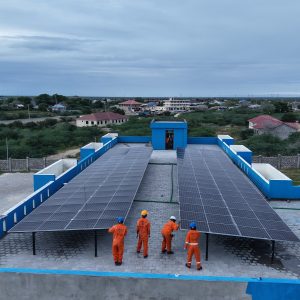
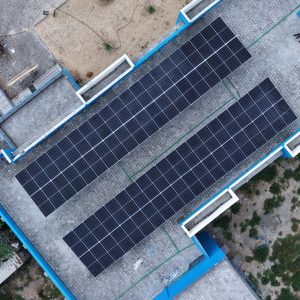
B. Solar PV Array: 112 High-Efficiency Solar Panels
The proposed system uses 112 solar panels rated between 550W and 620W each. These panels form the primary energy-generation component of the installation.
During daylight hours, the panels convert sunlight into DC electricity, which the hybrid inverter converts into usable AC electricity for the connected loads.
The array can also provide energy for charging the compatible battery bank, depending on solar production, load demand, and the system’s energy-management settings.
Solar panel specifications
| Specification | Details |
|---|---|
| Number of panels | 112 |
| Individual panel rating | 550W–620W |
| Total installed PV capacity at 550W | 61.6kWp |
| Total installed PV capacity at 600W | 67.2kWp |
| Total installed PV capacity at 620W | 69.44kWp |
| Panel technology | Depends on the selected module |
| Application | Commercial and industrial solar generation |
Advantages of the solar array
- Reduced electricity expenses: Solar generation can offset electricity purchased from the grid, particularly during daylight hours.
- Reliable daytime energy production: The array can supply a substantial proportion of a business’s daytime energy requirements when sufficient sunlight is available.
- Support for battery charging: Excess solar generation can charge the high-voltage battery bank when the battery has available capacity.
- Scalable energy solution: The array can form part of a larger energy-management system, provided the inverter and battery equipment are correctly matched.
- Long-term energy savings: A properly designed installation can help reduce exposure to rising electricity tariffs.
Actual energy production depends on the selected panel rating, local solar irradiance, panel orientation, shading, operating temperature, system losses, and other site conditions.
Important design consideration: The proposed 112-panel array has a total capacity of approximately 61.6–69.44kWp, depending on the panel rating. This is below the inverter’s stated 80kW built-in MPPT capacity. The proposed array can therefore utilise part of the available solar input capacity, subject to the inverter manufacturer’s permitted PV sizing and electrical limits.
3. Proposed Solar Panel String Configuration
The proposed arrangement divides the 112 panels into four groups:
| MPPT group | Panels per group | Total panels |
|---|---|---|
| MPPT 1 | 28 panels (14 × 2) | 28 |
| MPPT 2 | 28 panels (14 × 2) | 28 |
| MPPT 3 | 28 panels (14 × 2) | 28 |
| MPPT 4 | 28 panels (14 × 2) | 28 |
| Total | 112 panels | 112 |
This is a proposed grouping rather than a confirmed electrical string design. The notation of 14 × 2 per group must be checked against the inverter’s actual wiring diagram and the electrical characteristics of the selected modules.
Before installation, a qualified solar engineer should verify:
- The number of modules permitted in series in each string.
- The maximum open-circuit voltage of each string under the site’s lowest expected temperature.
- The operating voltage of each string against the MPPT operating range.
- The short-circuit current and operating current against the inverter’s input limits.
- The correct allocation of strings across the eight physical PV input ports.
- Whether parallel strings are permitted on each input and whether additional string protection is required.
Note: Four MPPT trackers and eight PV input ports do not necessarily mean that all eight ports can accept any string arrangement. The final design must follow the manufacturer’s electrical specifications.
4. High-Voltage Lithium Battery Storage
The inverter supports a high-voltage battery input range of 160–800V DC, allowing the system to be paired with a compatible high-voltage lithium battery bank.
The battery bank stores surplus solar energy generated during the day for use when solar production is low or unavailable.
For a commercial installation, the appropriate battery capacity should be determined by the facility’s nighttime energy consumption, required backup duration, critical loads, and the amount of energy available for charging the batteries during the day.
Advantages of high-voltage battery storage
1. Backup electricity during grid outages
When the system is configured for backup operation and sufficient battery energy is available, the batteries can supply supported loads during a grid outage.
2. Better utilisation of solar energy
Surplus daytime solar electricity can be stored rather than being immediately lost to curtailment, provided the batteries have sufficient available capacity and the system is configured to charge them.
3. Reduced reliance on grid electricity
Stored solar energy can be used during evening hours and other periods when PV production is insufficient, reducing the amount of electricity purchased from the grid.
4. Flexible energy management
A properly configured hybrid system can coordinate solar production, battery charging and discharging, and grid electricity according to the site’s operating requirements.
Important: The battery capacity has not yet been specified. The inverter’s 160–800V DC battery input range alone does not determine how many hours the system can operate on battery power. A compatible battery bank must be selected and sized separately.
5. Applications of the 55KVA / 50kW Hybrid Solar System
The proposed system is suitable for a range of commercial and industrial applications, subject to the actual load profile and battery configuration.
Commercial buildings and offices
Can help power lighting, computers, office equipment, air conditioning, and other compatible electrical loads.
Manufacturing and processing facilities
Can provide solar electricity for machinery, production equipment, and auxiliary systems where the equipment’s operating and starting requirements are within the inverter’s capabilities.
Hotels, lodges, and hospitality facilities
Can offset daytime electricity consumption from lighting, refrigeration, water pumps, laundry equipment, and other suitable loads.
Farms and agricultural facilities
Can support irrigation pumps, agricultural processing equipment, refrigeration, and other farm operations when correctly sized.
Schools and institutions
Can help reduce grid electricity consumption for lighting, offices, laboratories, and other electrical equipment.
Warehouses and distribution centres
Can provide solar power for lighting, offices, refrigeration, and selected operational equipment.
6. Key Advantages of the Complete System
The proposed 55KVA / 50kW Felicity hybrid solar system offers the following benefits:
- High-capacity three-phase power: Designed for substantial commercial and industrial electricity requirements.
- Large solar-generation potential: Supports a proposed 112-panel array with a capacity of 61.6–69.44kWp.
- Integrated energy management: Combines solar generation, grid integration, and compatible high-voltage battery storage.
- Reduced electricity bills: Solar generation can offset grid electricity consumption.
- Backup power capability: Supports backup operation when correctly configured with a suitable battery bank and compatible loads.
- Four MPPT trackers: Provides flexibility when designing and optimising the PV array.
- IP65 enclosure protection: Offers dust and water-jet protection under specified conditions.
- Flexible commercial applications: Can be considered for offices, factories, farms, hotels, institutions, and other suitable facilities.
- Potential for improved energy independence: Reduces dependence on grid electricity when solar production and battery storage are sufficient.
- Expandable system design: Additional compatible solar or storage capacity may be possible, subject to equipment limits and an approved system design.
7. Important Installation and Design Considerations
To achieve safe, reliable, and efficient operation, the system should be designed and installed by qualified solar professionals.
The installation should include appropriately rated DC isolators, PV string protection where required, surge protection devices, AC protection, earthing and bonding, suitable cable sizing, and battery protection.
The following points should be confirmed before procurement and installation:
- Inverter rating: Confirm the manufacturer’s continuous active-power rating and operating limits.
- PV array: Verify the selected panel wattage and final string configuration against the inverter datasheet.
- Battery bank: Select a compatible high-voltage battery system and battery management equipment.
- Backup duration: Calculate the battery capacity from the site’s critical loads and desired backup hours.
- Grid integration: Confirm local grid requirements and any approvals required for grid-connected or export-capable operation.
- Installation environment: Follow the manufacturer’s temperature, clearance, ventilation, and mounting requirements.
Actual solar output and backup duration will depend on the installed equipment, site conditions, load demand, and system settings.
8. Conclusion
The Felicity IVGM50KHP3G2 55KVA / 50kW High-Voltage Three-Phase Hybrid Solar System is a commercial and industrial energy solution designed to combine substantial solar generation with grid integration and high-voltage battery storage.
Its 50kW rated active-power output, built-in 80kW MPPT capacity, four MPPT trackers, eight PV input ports, 160–800V DC battery input range, and IP65 enclosure make it a promising option for businesses seeking to reduce electricity expenses and improve power reliability.
With the proposed 112 solar panels rated between 550W and 620W, the system would have an installed solar capacity of 61.6–69.44kWp. When paired with a suitably sized and compatible high-voltage battery bank, it can provide a flexible energy solution for commercial buildings, industrial facilities, farms, hotels, and other businesses with significant electricity requirements.
The final system configuration should be confirmed against the manufacturer’s datasheet and the site’s electrical load assessment to ensure safe operation, correct PV string sizing, and the desired level of backup power.
Reviews
There are no reviews yet.