
Description
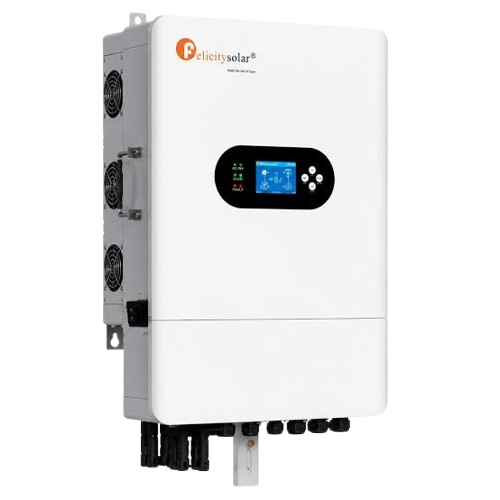
17.6KVA / 16KW IVGM16KLP1G1 Single-Phase Hybrid Solar Inverter – Detailed Description, Specifications and Advantages
1. Product Overview
The IVGM16KLP1G1 17.6KVA / 16KW Single-Phase Hybrid Solar Inverter is a high-capacity, intelligent solar power conversion solution designed for residential, commercial, and light-industrial applications requiring reliable electricity, high solar generation capacity, and efficient battery storage integration.
Operating on a 48V battery system, this advanced hybrid inverter supports both on-grid and off-grid operation, allowing users to harness solar energy, integrate battery storage, and connect to the utility grid or a compatible backup generator, subject to the manufacturer’s supported configurations.
With a rated output power of 16kW and a maximum photovoltaic (PV) input capacity of 25,600W (25.6kW), the inverter can accommodate a substantial solar panel array. Its three independent PV input ports provide flexibility when designing a solar installation, making it suitable for properties with large electricity demands.
The inverter supports a PV input voltage range of 150–425V DC per input port and a maximum input current of 26A per port, according to the specifications provided. It can be configured for up to 42 solar panels rated between 550W and 620W, subject to the manufacturer’s detailed string configuration and electrical limits.
Additionally, the inverter comes with a Wi-Fi monitoring module, enabling users to monitor solar generation, inverter performance, and other available system information remotely through a compatible monitoring platform.
This makes the IVGM16KLP1G1 an excellent option for customers seeking a powerful, expandable, and intelligent solar energy solution.
2. Technical Specifications
| Specification | Details |
|---|---|
| Model | IVGM16KLP1G1 |
| Inverter apparent power rating | 17.6kVA |
| Rated active power output | 16kW |
| Inverter type | Hybrid solar inverter |
| Operating modes | On-grid and off-grid |
| Phase configuration | Single-phase |
| Battery system voltage | 48V |
| Maximum PV input power | 25,600W (25.6kW) |
| Number of PV input ports | 3 |
| PV input voltage range | 150–425V DC per port |
| Maximum PV input current | 26A + 26A + 26A |
| Solar panel compatibility | 550W–620W modules, subject to electrical compatibility |
| Maximum proposed panel quantity | 42 panels, subject to verification of the manufacturer’s PV limits |
| Proposed panel arrangement | 7 panels per string × 2 strings per input port |
| Proposed PV configuration | 7 × 2 + 7 × 2 + 7 × 2 |
| Monitoring | Wi-Fi monitoring module |
| Installation applications | Residential, commercial and light-industrial properties |
| Battery compatibility | Compatible 48V battery systems, subject to manufacturer specifications |
| Protection rating | IP65, as specified for this model |
Important design note: The proposed configuration of 42 panels must be checked against the inverter’s official maximum PV input power, maximum input current per MPPT, maximum short-circuit current, and permissible string voltage. The final panel quantity and string arrangement should be confirmed using the exact solar panel datasheet and inverter manual before installation.
3. High-Capacity 16kW Power Output
One of the main advantages of the IVGM16KLP1G1 is its 16kW rated active power output, supported by a 17.6kVA apparent power rating.
This capacity makes it suitable for properties operating several electrical appliances and equipment simultaneously, provided their combined running power, starting currents, and power factor remain within the inverter’s limits.
Potential applications include:
- Large residential homes with multiple electrical appliances.
- Offices and commercial premises.
- Retail shops and supermarkets.
- Hotels, lodges, and guest houses.
- Schools and educational facilities.
- Workshops and selected light-industrial operations.
- Agricultural facilities and selected farm equipment.
- Water pumping systems with compatible motor starting requirements.
- Small businesses seeking to reduce dependence on grid electricity.
The 16kW output gives users greater flexibility to operate multiple loads from a single inverter rather than relying on several smaller inverter units.
Practical consideration: Equipment such as electric heaters, welding machines, large pumps, compressors, and other motor-driven appliances should be assessed individually because their starting current may be significantly higher than their normal operating current.
4. Large 25.6kW Maximum Solar PV Input
The inverter supports a stated maximum photovoltaic input capacity of 25,600W (25.6kW), allowing a substantial solar array to be connected when designed within the manufacturer’s electrical limits.
A properly designed solar array can generate electricity during daylight hours to supply the property’s electrical loads, charge compatible batteries, and potentially export surplus power where the grid connection and applicable regulations permit.
Benefits of the large PV input capacity
A. Increased solar energy production
A large solar array provides the potential to generate more electricity during sunny periods, helping meet daytime consumption requirements.
B. Reduced electricity bills
Solar power can reduce the amount of electricity purchased from the utility provider, depending on the property’s consumption patterns and available sunlight.
C. Support for battery charging
When solar generation exceeds the power being consumed by connected loads, available surplus energy can be used to charge compatible batteries, subject to the inverter’s charging limits and configuration.
D. Better support for daytime commercial operations
Businesses with significant daytime electricity consumption can benefit from generating electricity directly from their solar panels instead of purchasing all their energy from the grid.
E. Flexible system design
The high PV input capacity allows system designers to plan a substantial solar installation around the building’s available roof area, energy demand, and battery storage requirements.
Actual daily energy production will depend on solar irradiance, panel orientation, shading, temperature, system losses, and the inverter’s operating conditions.
5. Three PV Input Ports for Flexible Solar Array Design
The IVGM16KLP1G1 features three PV input ports, each with a stated operating voltage range of 150–425V DC and a maximum input current of 26A.
This arrangement can offer greater flexibility when designing a solar installation, particularly where the available roof space has different orientations or where the solar array is distributed across separate roof sections.
Proposed solar panel arrangement
Based on your proposed configuration:
- PV Input 1: 14 solar panels, arranged as two strings of seven panels.
- PV Input 2: 14 solar panels, arranged as two strings of seven panels.
- PV Input 3: 14 solar panels, arranged as two strings of seven panels.
- Total proposed quantity: 42 solar panels.
Each input would therefore have two parallel strings, with seven panels connected in series per string.
However, this configuration should not be treated as approved until the inverter’s MPPT arrangement and input-current limits are verified.
Important PV compatibility considerations
The proposed 42-panel configuration requires careful verification for the following reasons:
- Maximum PV power: The total panel nameplate capacity must be assessed against the stated 25.6kW maximum PV input.
- Operating current: The combined current of parallel strings must remain within the relevant input or MPPT limit.
- Open-circuit voltage: The total string voltage under the coldest expected conditions must not exceed the inverter’s maximum permissible PV voltage.
- MPPT compatibility: The inverter’s actual number of MPPT trackers and the number of strings each tracker can accept must be confirmed.
- Panel characteristics: The selected modules’ operating current, short-circuit current, operating voltage, and open-circuit voltage must be checked against the inverter manual.
These checks are particularly important when using modern high-wattage solar panels, which can have relatively high output currents.
6. Compatibility with 550W–620W Solar Panels
The inverter can be considered for use with high-wattage solar modules in the 550W–620W category, provided the electrical characteristics of the selected panels comply with the manufacturer’s requirements.
These panels are suitable candidates for large solar installations because they can deliver substantial nameplate power from a relatively small number of modules.
Advantages of high-wattage solar panels
- Fewer panels for a given array capacity: Higher-wattage modules can reduce the number of panels required to achieve a particular installed capacity.
- Efficient use of roof space: They can help maximise generation where roof space is limited.
- Reduced balance-of-system requirements: Depending on the installation design, fewer modules may reduce the number of mounting points and some associated installation components.
- Suitable for commercial projects: High-wattage panels are useful for properties with substantial daytime energy consumption.
Understanding the proposed 42-panel arrangement
The total nominal panel capacity depends on the selected module rating:
| Panel rating | Total for 42 panels |
|---|---|
| 550W | 23,100W (23.1kW) |
| 580W | 24,360W (24.36kW) |
| 600W | 25,200W (25.2kW) |
| 610W | 25,620W (25.62kW) |
| 620W | 26,040W (26.04kW) |
Important: A 42-panel array using 610W or 620W modules would exceed the stated 25.6kW maximum PV input on a nameplate-power basis. Even where a manufacturer’s design permits some PV oversizing, that permission must be confirmed in the official documentation. A 42-panel arrangement using 600W modules totals 25.2kW, but it still requires the voltage and current checks described above.
7. On-Grid and Off-Grid Hybrid Operation
The IVGM16KLP1G1 is described as an on-grid/off-grid hybrid inverter, offering flexibility for installations that need to use solar power alongside battery storage and a grid supply.
On-grid operation
When connected to a compatible utility supply, the inverter can be configured to integrate solar generation with the property’s electricity supply, subject to its supported operating modes.
Potential benefits include:
- Using available solar power to supply electrical loads.
- Reducing reliance on utility electricity during periods of solar generation.
- Charging batteries when conditions and settings permit.
- Supporting energy management between solar generation, battery storage, and the grid.
Grid export should only be enabled where the inverter supports the required export functionality and the installation complies with the utility provider’s interconnection requirements.
Off-grid operation
In a compatible off-grid configuration, the inverter can supply supported loads from solar generation and battery storage without depending on a live utility connection.
This is particularly valuable for properties in areas where grid electricity is unreliable or unavailable.
Potential applications include:
- Rural homes and farms.
- Remote commercial properties.
- Facilities requiring backup electricity.
- Businesses operating in areas with frequent power interruptions.
The ability to operate off-grid depends on the inverter’s supported configuration, available battery capacity, solar generation, and connected loads.
8. 48V Battery System Compatibility
The inverter operates with a 48V battery system, making compatible low-voltage battery storage an important component of the installation.
Battery storage allows excess solar energy generated during the day to be stored and used later when solar production falls, such as in the evening or during a power interruption.
Benefits of battery integration
A. Backup electricity
A correctly configured battery bank can provide power to supported loads when the utility supply fails, subject to the inverter’s transfer characteristics and system configuration.
B. Improved solar energy utilisation
Instead of relying exclusively on immediate daytime solar generation, users can store some of the energy generated for use later.
C. Reduced dependence on the grid
A suitably sized battery can reduce the need to purchase electricity during periods when solar production is low.
D. Flexible storage capacity
The battery bank can be sized according to the property’s energy consumption, desired backup duration, and budget, provided the inverter supports the selected battery configuration.
Battery sizing considerations
The required battery capacity depends on the amount of energy consumed during the intended backup period.
For example, a load consuming 5kW continuously for four hours requires 20kWh of usable energy before accounting for conversion losses and battery operating limits.
The inverter’s 48V designation alone does not establish its maximum battery charging current, maximum discharge current, or battery compatibility. These specifications should be confirmed before selecting a battery bank.
9. Built-In Wi-Fi Monitoring Module
The supplied Wi-Fi monitoring module enables remote monitoring through the manufacturer’s compatible monitoring platform.
Depending on the supported application and inverter firmware, the monitoring system may provide information about solar generation, inverter output, battery status, grid supply, and system operating conditions.
Advantages of Wi-Fi monitoring
- Remote system monitoring: Check available system information without needing to stand beside the inverter.
- Solar generation tracking: Review recorded solar production where supported.
- Battery monitoring: View available battery information when the battery and inverter communicate correctly.
- Performance assessment: Identify changes in system performance that may require investigation.
- Convenient maintenance: Help installers and system owners assess system operation remotely.
- Improved energy management: Use recorded data to understand solar production and consumption patterns.
Wi-Fi monitoring requires a compatible network, application, and properly configured monitoring device. The exact monitoring functions depend on the manufacturer’s platform.
10. IP65 Protection Rating
The inverter is specified as having an IP65 protection rating.
Under the standard IP classification, the first digit indicates protection against dust ingress, while the second indicates protection against water jets.
An IP65 rating means the enclosure is dust-tight and protected against water jets under the applicable test conditions.
Advantages of IP65 protection
- Protection against dust entering the enclosure under rated test conditions.
- Resistance to water jets from different directions under rated test conditions.
- Greater installation flexibility than equipment designed exclusively for protected indoor environments.
- Suitability for appropriately designed installations in locations where dust exposure is a consideration.
Nevertheless, IP65 does not mean the inverter is waterproof under every circumstance or suitable for submersion.
For installations in Kenya, particularly in hot, dusty, or coastal environments, the installer should follow the manufacturer’s requirements for mounting, ventilation, direct sunlight exposure, corrosion protection, and environmental clearances.
11. Potential Applications of the IVGM16KLP1G1
With its 16kW output and substantial solar input capability, this inverter can be considered for a range of residential and commercial installations.
Residential applications
- Large homes with several electrical appliances.
- Homes using refrigerators, washing machines, televisions, lighting, and computers.
- Properties requiring battery backup during power interruptions.
- Homes with compatible water pumps and other moderate-power equipment.
Commercial applications
- Offices and retail shops.
- Small supermarkets.
- Restaurants and guest houses.
- Salons and selected service businesses.
- Schools and training facilities.
- Small workshops with compatible electrical loads.
Agricultural applications
- Selected water pumping systems.
- Farm buildings and agricultural facilities.
- Poultry houses with suitable electrical loads.
- Other agricultural operations where the running and starting requirements fall within the inverter’s limits.
For installations involving motors, refrigeration compressors, or other equipment with high starting currents, the system designer should check the inverter’s surge capacity and overload characteristics.
12. Key Advantages of the IVGM16KLP1G1 Hybrid Solar Inverter
The principal benefits of this inverter include:
- High 16kW output capacity: Supports substantial electrical loads when correctly sized.
- 17.6kVA apparent power rating: Provides an apparent power rating suited to a range of electrical applications, subject to power factor and output limits.
- Up to 25.6kW stated PV input: Accommodates a substantial solar array within the manufacturer’s approved limits.
- Three PV input ports: Provides flexibility when designing the solar array.
- 48V battery integration: Supports energy storage using compatible battery systems.
- On-grid/off-grid functionality: Offers flexibility for different power supply arrangements.
- Wi-Fi monitoring: Enables convenient remote access to supported system information.
- IP65 enclosure protection: Provides dust-tight and water-jet protection under rated test conditions.
- Compatibility with high-wattage PV modules: Can be considered for modern solar modules within the inverter’s voltage and current limits.
- Potential reduction in electricity costs: Solar generation can reduce grid electricity purchases when aligned with the property’s energy consumption.
- Backup power potential: A correctly sized battery bank can support selected loads during utility outages.
- Flexible residential and commercial applications: Can serve a range of installations following a professional load assessment.
13. Recommended Design Considerations Before Installation
To achieve safe and reliable operation, the following should be established before installing the IVGM16KLP1G1:
- Confirm the official inverter datasheet and installation manual.
- Verify the maximum permitted PV input power and whether any PV oversizing is allowed.
- Confirm the number of MPPT trackers and the permitted number of strings per tracker.
- Check each string’s operating voltage and cold-weather open-circuit voltage.
- Confirm the combined operating and short-circuit currents of parallel strings.
- Select a compatible 48V battery and verify its continuous charge and discharge current ratings.
- Size DC and AC cables according to the installation design and applicable electrical standards.
- Install correctly rated circuit breakers, isolators, surge protection, and earthing.
- Verify the inverter’s surge capacity against the starting requirements of motors and other demanding loads.
- Ensure the mounting location meets the manufacturer’s ventilation and environmental requirements.
- Confirm the required grid interconnection and export settings where applicable.
Particular attention should be given to the proposed 42-panel arrangement. Although the panel count and wattages can produce an array close to the inverter’s stated maximum PV input, the final design must comply with the manufacturer’s electrical limits. The inverter should not be connected to the proposed configuration until these limits have been verified.
Conclusion
The IVGM16KLP1G1 17.6KVA / 16KW Single-Phase Hybrid Solar Inverter is a high-capacity solar power solution designed for residential and commercial customers seeking to combine solar generation, compatible battery storage, and flexible grid or off-grid operation.
Its key features include a 16kW rated output, 48V battery architecture, stated maximum PV input of 25.6kW, three PV input ports, IP65 enclosure protection, and Wi-Fi monitoring.
When paired with a properly designed solar array and a compatible battery bank, it can help customers reduce dependence on utility electricity, improve solar energy utilisation, and maintain power to supported loads during grid interruptions.
For the best results, the solar array, battery storage, protection devices, and connected loads should all be sized to the manufacturer’s specifications and the customer’s actual energy requirements.


Reviews
There are no reviews yet.